Live Webinar · For ARC-PA Accredited Physician Assistant Programs

Teaching Your Faculty to Analyze C1.01 and C1.02

A one-hour working session on running the seven Sixth Edition assessment questions as a faculty exercise, not a writing task.

Included with registration

The Critical Analysis Laboratory

A faculty worksheet for all seven questions.

Reporting the data is not analyzing it.


Under the Sixth Edition, Standard C1.01 asks five questions and C1.02 asks two. Most programs can answer them with numbers. Fewer can show a reviewer how their faculty got from the numbers to the conclusion.

The gap shows up in familiar ways. A benchmark is met and the analysis stops. Three unrelated data points are called triangulation. A rotation changes with no finding behind it. Each one is a training problem before it is a documentation problem.

This session lays out the faculty development method the MACS team uses with programs: the same seven questions, a six-step worksheet, trigger criteria set before anyone sees the results, and a meeting format that builds the evidence trail as it goes. It has been updated with lessons from mSSR and site-visit observations.

In brief

Teaching faculty to analyze C1.01 and C1.02 means making the analysis a repeatable meeting exercise: define the question, load the required data, review benchmark and trend, contextualize, synthesize, triangulate, and apply trigger criteria set in advance. The output is a documented conclusion an external reviewer can follow without asking.

Seven steps, every meeting.


  1. Define the question
  2. Load the data
  3. Benchmark and trend
  4. Contextualize
  5. Synthesize
  6. Triangulate
  7. Apply the trigger

The training model is not a one-time accreditation exercise. Faculty use the same workflow in assessment committee meetings, faculty meetings and data retreats until they can explain the program's reasoning on their own.

The hour, section by section.


  1. The training model

    Why C1.01 and C1.02 analysis belongs in the regular meeting cycle, not in the months before a self-study is due.

  2. Critical analysis and trigger criteria

    Interpret, contextualize, integrate, decide. The four triggers that separate a data signal from an area needing improvement, and why they are set before results are reviewed.

  3. Four lessons from review

    Narrative-to-table traceability, why a met benchmark does not end the analysis, triangulation that fits the question, and the evidence trail every programmatic change needs.

  4. The five C1.01 questions

    Each question with its required anchor data, worked through the six-step worksheet, plus a trend exercise that goes past “benchmark met.”

  5. The two C1.02 questions

    Principal faculty and administrative staff sufficiency: number, capacity, workload and perceptions, analyzed together.

  6. Running it with faculty

    Small-group assignments, the external reviewer test, the facilitator debrief, and the records that show the framework is in continued use.

What you take to your next faculty meeting.


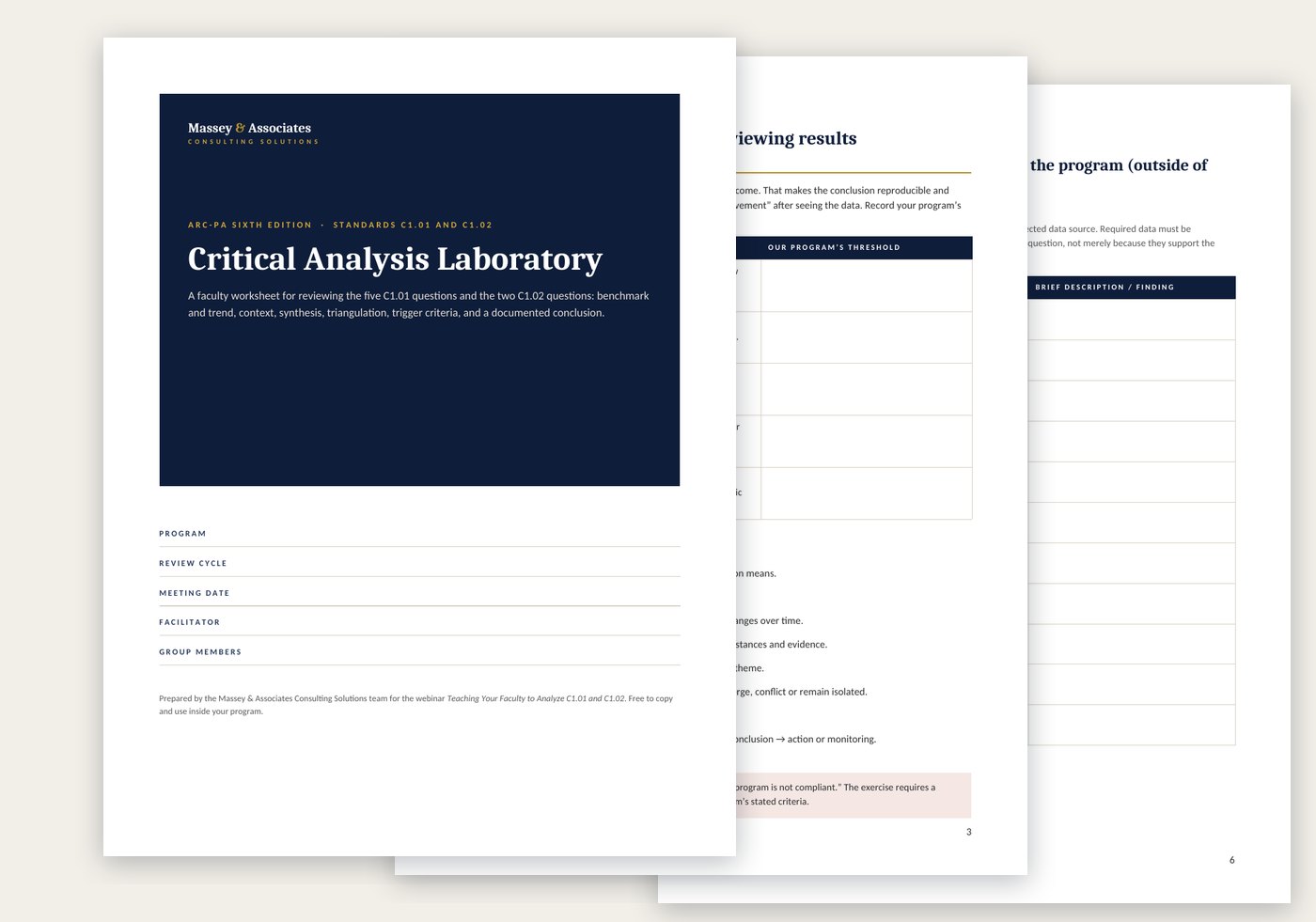
Pages from the Critical Analysis Laboratory worksheet: the cover, the trigger criteria table, and a C1.01 data inventory
The Critical Analysis Laboratory: a data inventory, six analysis prompts, a decision record and an action plan for each of the seven questions.
  1. How to set trigger criteria before results are reviewed, so “needs improvement” means the same thing after the data arrive as it did before.
  2. When a met benchmark still needs analysis: direction over time, proximity to the threshold, and related measures that move in opposite directions.
  3. How to test a conclusion the way a reviewer will: every claim traceable to a table, every material trend interpreted, every change linked to a finding.
  4. How to run the exercise in one faculty meeting, with small groups, one question each, and a documented disposition at the end.

Friday, October 30 at noon Eastern. One hour, free.

Reserve Your Spot

Built for the people who run assessment, not an orientation for newcomers.


Program Directors

Responsible for showing a reviewer that the faculty, not one person, can explain the program's assessment conclusions.

Assessment Committee Chairs

Running the data analytics or assessment meetings where C1.01 and C1.02 evidence is reviewed.

Principal Faculty

Asked to interpret program data and defend conclusions, often without having been trained to do either.

Programs Facing a Self-Study

Preparing an SSR or mSSR narrative under the Sixth Edition in the coming cycle.

Your Presenter

Twenty-one years as a PA program director.


Scott Massey, PhD, PA-C

Scott Massey, PhD, PA-C

Founder & Principal Consultant

Scott Massey has spent 31 years in health-science higher education, 21 of them as a program director across four PA programs. He has consulted on provisional, continuing and probationary accreditation for more than thirty programs.

His published research covers PANCE prediction, the correlation between formative and summative assessment, and predictive analytics applied to the PA-CAT, which is the data work C1.01 now asks faculty to do.

31Years in Health-Science Higher Education
21Years as a Program Director
4PA Programs Directed
30+Programs Guided Through Accreditation

This session draws on what our consultants have seen in mock site visits and in self-study and mSSR reviews under the Sixth Edition standards.

There is more to this story.


The webinar is one hour of the MACS two-day faculty training workshop. Programs that want to go further usually take one of two routes.

Two-day faculty training workshop

Your faculty work the laboratory with your own program's data, facilitated by MACS consultants, including the reviewer stress tests the public session only names.

Support through the accreditation cycle

MACS consultants oversee the Sixth Edition self-study for programs entering an accreditation cycle, from the data packet to the final narrative.

Book a Call

Thirty minutes with the team. No obligation.

Frequently Asked

Before you register.


Is the webinar free, and will I get the recording?+

Yes, it is free. Everyone who registers receives the recording and the Critical Analysis Laboratory worksheet, whether or not they attend live. The replay is also published on this page after the session, with chapter navigation and a full transcript.

What is the Critical Analysis Laboratory worksheet?+

A faculty worksheet for the five C1.01 questions and the two C1.02 questions. It opens with a table for setting your program's trigger criteria and a common group workflow. Each question then gets a data inventory, six analysis prompts, a conclusion record, and an action plan.

Do I need to have watched the earlier C1.01 and C1.02 webinars?+

No. The earlier sessions covered what each question asks and how to reach a conclusion on it. This one covers how to train your faculty to do that analysis themselves, in a meeting, as a repeatable exercise. The replays are linked below if you want the background.

Can our faculty attend together?+

Yes. Faculty can register individually, or a program can watch together in one room. The worksheet is built for small groups, so a program that watches together can try the exercise the same week.

Will I get a copy of the slides?+

Slide decks are not distributed. The worksheet carries the method in a form faculty can use, and the replay page carries the rest: the recording, chapter navigation, and the full transcript.

Can MACS run this exercise with our own faculty?+

Yes. The webinar is one hour of the MACS two-day faculty training workshop, in which faculty work the laboratory with the program's own data. Programs entering an accreditation cycle can also have MACS consultants oversee the Sixth Edition self-study. Book a call to talk it through.

The earlier sessions in this series.


One hour. Seven questions, one method.

Worksheet included.

Reserve Your Spot

Free. Friday, October 30, 2026 at 12:00 PM Eastern. The recording and worksheet go to every registrant.